|
Peter Masters |
Peter Masters |
|
|
 |
||||
 |
|||||||||
| About me | About this site | My books |  |
||||||
Humiliation

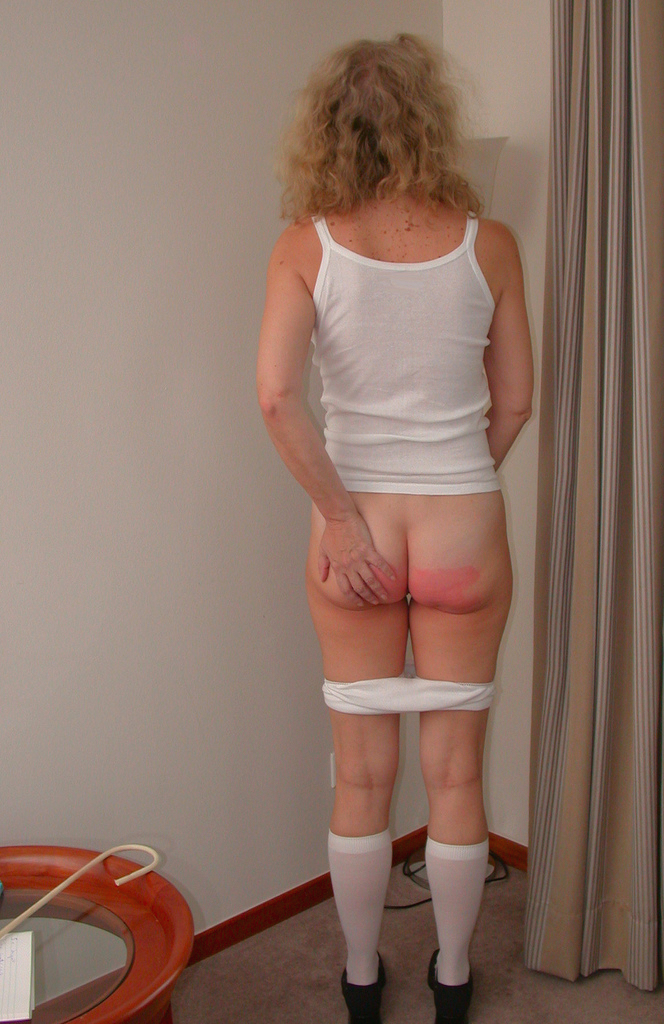
Standing in the corner after a spanking
Humiliation is a BDSM psychological activity which exploits the identity structures of the bottom or submissive. It typically involves exploring aspects of the bottom or submissive which have to do with:
- Areas in which they lack confidence, and
- Embarrassment.
Humiliation can satisfy a number BDSM motivations, such as:
- Experiencing the power of one's partner,
- Uncovering the True Self, and
- Creating or inspiring emotional intimacy and bonding through experiencing one's identity weaknesses exposed.
Contents
Malicious humiliation versus constructive humiliation
All BDSM should lead to positive outcomes for the participants and humiliation is no exception. Malicious humiliation is intentional and destructive and leads to one or more of the outcomes listed in this article on abuse. We could identify malicious humiliation as having a deliberate intent to cause harm and this puts it in the realm of true sadism.
Constructive humiliation, on the other hand, leads to a positive outcome, such as personal growth, catharsis, greater intimacy with your partner, of many of the other outcomes listed in this article on motivations.
How it works
In common with many BDSM activities, there is a marked disparity of power involved in humiliation, and much of the play involves exercising this power difference. This leads to one partner experiencing the power of their partner to impact their sense of self and identity, and the other wielding the words and actions to cause this impact.
In regards to humiliation, the value of self is involved in two ways:
- Many, if not most, people, measure themselves, and thus gain a sense of their own worth or value, against how others feel or react towards them (value by reflection),
- They also maintain their own---sometimes idealised---idea of what usually-hidden aspects of themselves are worth (self valuation)
Value by reflection
In a private context, such as a dungeon, and particularly when the humiliator is well-known and trusted by the humiliatee, the humiliator is well-placed to use words and actions such as insults, compliments, attaboys, and dismissive gestures to indicate how much or how little they value their play partner. Lacking any other external source of validation, the humiliatee can feel that they are dependent on their partner for their own sense of self-value. In this situation, the humiliatee can be very aware of this power their partner has over them, particular when the humiliator puts this power to use to raise and lower the humilatee's sense of value expressly to create this feeling of power (which they have) and helplessness (which the humiliatee experiences).
In effect, the trusted partner---the humiliator---replaces one or more of the foundation structures of their partner's identity with themselves temporarily. For more detail, see identity.
Self-maintained value
Most people don't look like supermodels and are rarely called upon to present themselves in all their glory in front of others. Thus body image is an aspect of self-value where a person will often come up with their own estimation of what their body is like and will protect that valuation by not exposing themselves in situations where they may be criticised. This is fertile ground for humiliation by requiring the humiliatee to expose themselves in front of others, e.g., parade around naked, or serve other people at a party while naked.
No insults or dismissive gestures are required for this because their sense of self-value immediately becomes under threat by having their body exposed for valuation by others, even when no valuation actually or obviously occurs.
The top or dominant becomes the person who compels the humiliatee to confront themselves. Thus the self-value of the humiliatee is controlled by how much of themselves they are forced to confront.
Strategies
There are many strategies which can be used to cause humiliation. They can involve what is said to a submissive or bottom, what is done to them, or what they are required to do. Here are a few of the sorts of things which may be effective on some submissives or bottoms.
Verbal
- Insults
- Use of diminutive terms ("little one")
- Criticism of skills, characteristics or abilities
- Comments regarding attractiveness
- Criticism of sexual ability or desirability
- Ridicule ("You call those breasts??")
Gestures and actions
- Being pissed on
- Being ignored
Exposure
- Being required to toilet in front of others or as an animal might
- Being required to perform degrading service---such as a business executive being required to do menial clean up duties in a house
- Being required to wear degrading clothes or decorations; cross-dressing; nudity
- Being required to walk around in chains
Behaviours
- Needing to seek permission to do everyday activities---such as use the toilet, leave the room, go out with friends, etc.
- Adopting rituals which emphasise diminished status---such as speaking deferentially, begging permission to speak, or bowing when entering or leaving the room.
Caution
Consider also the sacred nature of some aspects of the identity which may be utilised during humiliation. While some parts of the identity are not particularly important overall, some parts can reach the status of "sacred"---such as, for example, ability to be a good parent---and their involvement in humiliation play can be particularly powerful. Perhaps more often than not, sacred parts of the identity should be left out of humiliation play due to risk of harm and for the potential for stuffing up the relationship between the two people involved.